
The Hidden Cost Of Synthetic Identities And How IDQA Prevents Them
Synthetic identity fraud costs lenders billions. Discover the hidden operational, regulatory, and customer churn costs—and how IDQA reliability scoring prevents them.
Read articleFor Security & Compliance Practitioners
Fraudulent, stolen, and synthetic identities cost enterprises billions. IDQA — Identity Quality Assurance — gives you a measurable, composable score for identity reliability. Stop relying on guesswork.
The cost of uncertainty
Every day, organizations rely on identity claims they cannot verify. The result is exposure, loss, and erosion of trust.
of enterprises experienced identity fraud in the past 12 months — synthetic identities are the fastest-growing vector.
lost globally to identity-related fraud in the last reporting year across banking, healthcare, and government.
compliance officers say they lack a reliable metric to assess the trustworthiness of a digital identity.
of organizations still rely on manual review processes that cannot scale with modern attack velocity.
What is measurable reliability?
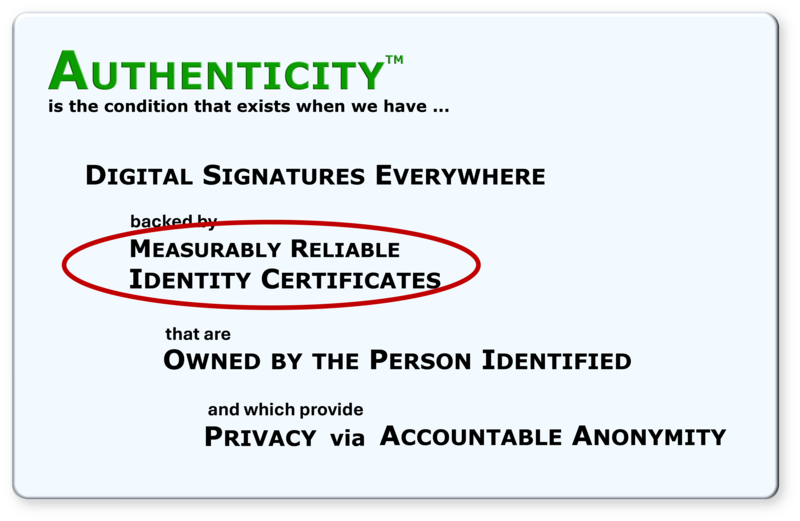
Digital identities can never be 100% reliable — the human element carries inherent uncertainty. But we can now measure reliability with precision. IDQA gives you a confidence score that anyone depending on a digital identity can use.
“Measurable reliability means that anyone who is depending upon your digital identity can see a score that measures the reliability of that identity. It’s not about personal character — it’s about the confidence level that a digital identity represents the real person.”
The IDQA framework
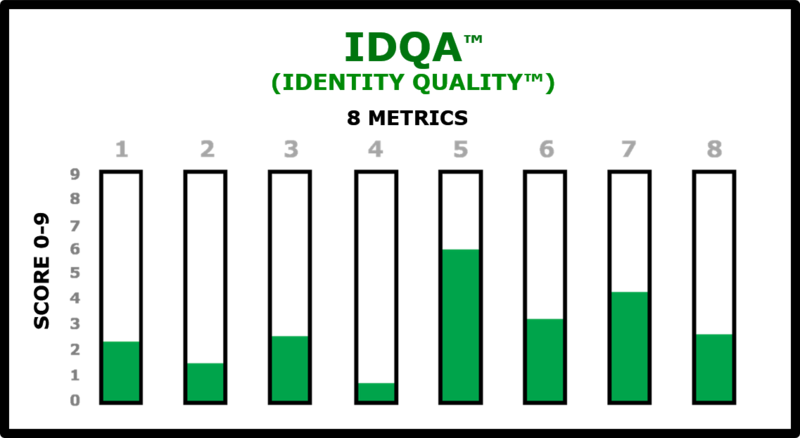
IDQA is a composite score built from eight dimensions, each measuring a distinct aspect of identity trustworthiness.
Sample IDQA composite — each bar represents one metric dimension.
How IDQA is calculated
Each of the eight metrics contributes to the overall IDQA score through a weighted model that reflects the specific risk profile of your use case.
Gather identity documentation, biometrics, and corroborating signals from trusted sources.
Each of the eight metrics is scored independently using a standardized 0–100 scale.
Configure weights based on your industry, regulation, and risk appetite.
A single composite score that makes identity reliability measurable and actionable.
Why it matters
IDQA transforms identity from a binary pass/fail into a strategic risk lever for security and compliance teams.
Flag synthetic and stolen identities before they cause damage by using IDQA thresholds that match your risk appetite.
Automate identity review decisions based on composite score — no more manual back-and-forth for low-risk claims.
Provide auditors with a transparent, measurable framework for identity assurance across KYC, AML, and GDPR programs.
Deploy consistent identity reliability standards across customer, partner, and workforce populations.
Replace siloed identity checks with a single composable metric that integrates into existing risk engines.
Signal to partners and customers that your identity infrastructure is based on measurable, auditable reliability.

Learn from the source
Explore the concepts behind measurable reliability and the IDQA framework in these introductory videos.
Thought leadership
Explore detailed articles on each of the eight metrics, calculation methodology, and enterprise deployment strategies.
Synthetic identity fraud costs lenders billions. Discover the hidden operational, regulatory, and customer churn costs—and how IDQA reliability scoring prevents them.
Read articleIdentity verification today relies on binary pass/fail gates, but fraud is a spectrum. Discover how IDQA replaces brittle checks with a continuous trust metric that adapts to risk.
Read articleArticles are being prepared. Check back soon for the complete IDQA metric breakdown series.
Common questions
IDQA is a measurement framework developed by the Authenticity Institute. It can be implemented by any organization that needs a composable, transparent identity reliability score. The framework is open and auditable.
No. IDQA complements existing programs by providing a unified, measurable reliability score that incorporates signals from multiple sources, including your existing identity verification stack.
The IDQA score is derived from evidence and signals — it does not require storing raw identity documents or biometric templates. The framework is designed with data minimization and user consent at its core.
No system can guarantee 100% reliability because of the inherent uncertainty in human identity claims. IDQA provides a transparent, measurable confidence score — enabling informed decisions rather than false certainty.
Begin by reviewing the eight metrics, assessing which identity evidence sources you already have, and contacting the Authenticity Alliance for implementation guidance and integration support.
Start the conversation
Join the enterprises of the Authenticity Alliance that are already putting IDQA to work. Get the full IDQA framework brief and implementation guide.
No commitment required. The brief includes full metric definitions, sample scorecards, and integration patterns.